
N Chandrasekaran not only faces muted financial performance from the group's listed companies, but also mounting losses at Tata Sons' unlisted subsidiaries, many of which have been set up by him in the last decade.

Indian listed companies experienced their fastest revenue growth in 15 quarters during Q1FY27, with combined net sales rising 18.4% year-on-year, while net profit grew 16%, primarily driven by mining, metals, and banking sectors, despite a contraction in operating margins due to higher input costs.

Tata Motors has launched the Curvv Series X, an updated version of its coupe-SUV, focusing on enhancing value-for-money by adding more features to lower and mid-spec variants and streamlining the lineup, with prices ranging from Rs 9.99 lakh to Rs 18.99 lakh (ex-showroom).

Tata Sons Chairman N Chandrasekaran has announced he will not seek reappointment when his current term concludes on February 20, 2027. This decision follows a lack of unanimous board support for his extension, despite recommendations from the majority shareholders, the Sir Dorabji Tata Trust and Sir Ratan Tata Trust. Chandrasekaran cited the need for leadership clarity amidst strategic projects and has requested the board to initiate a succession plan.

'We have a very demanding electorate which expects us to do something. So we will have to do something which is a bit out of the ordinary while at the same time keeping in mind the risk factors.'

Tata Motors' commercial vehicle (CV) business debuted on the BSE on Wednesday, completing the automaker's long-planned demerger into separate listed entities for its passenger and CV operations.

At an aggressive starting price of 18.79 lakh, the Tata Sierra.ev has a real-world range of 510 to 530 km with the 75 kWh battery pack on a single charge while the smaller 63 kWh battery coughs out a real-world range of 440 to 460 km, plus lifetime battery warranty as standard. And with the intelligent Quad-Wheel Drive system pushing out 504 Nm of torque, the EV flies from 0 to 100 km/h in just 5.8 seconds, says Rajesh Karkera.

N Chandrasekaran, the current Chairman of Tata Sons, has announced he will not seek reappointment when his term concludes on February 20, 2027, following a lack of unanimous board support for his extension.

Corporate leaders' half-life has shrunk over the past few decades. That is the Tata experience as well. Over 144 years till 2012, Tata Sons had just five chairmen. However, in the 15 years till 2027, the same group will see three, points out R Gopalakrishnan.
The search for N Chandrasekaran's successor as Tata Sons Chairman has reportedly narrowed to Tata Steel CEO T V Narendran, Tata Sons Executive Director Saurabh Agrawal, and NSE MD & CEO Ashish Chauhan, with Chauhan emerging as a potential 'dark horse' candidate.

'whom he believes in ... or whom he has faith in. But we don't know whether that person will be competent or not. This will lead to a lot of uncertainty in the minds of investors and shareholders of the Tata group companies.'
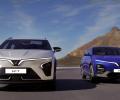
New players like Maruti Suzuki, VinFast, and Tesla are significantly expanding India's electric passenger vehicle (e-PV) market, capturing an 8.1 per cent share and contributing 18 per cent of incremental registrations in the first half of 2026, according to Fada Research data.

In the next 36 months nearly 25 to 40 per cent of jobs will be under threat from AI and job losses are inevitable.

Tata Motors Passenger Vehicles is the latest to come forward to honour them as the company has decided to present the team members with the soon-to-be-launched Tata Sierra.

With passenger vehicles (PVs), two-wheelers and three-wheelers registering double-digit growth, manufacturers raise production as the industry enters the festival season.
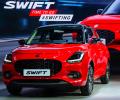
Passenger vehicle sales in India are estimated to have surged by nearly 25 per cent in June 2024, reaching approximately 4 lakh units, with Maruti Suzuki, Tata Motors PV, and Mahindra & Mahindra leading the growth, despite concerns over geopolitical tensions and monsoon impact.

India's passenger vehicle industry is poised for a record-breaking year in 2026, propelled by robust dispatches in the first half of the calendar year and strong demand for utility vehicles, despite facing several economic challenges.

Tata Motors Passenger Vehicles Ltd on Tuesday said it delivered over 1 lakh vehicles in 30 days from Navratri to Diwali, a growth of 33 per cent over the same period last year. The deliveries were led by SUVs with electric vehicles also showing strong traction, Tata Motors Passenger Vehicles Ltd managing director and CEO Shailesh Chandra said in a statement.

India's domestic passenger vehicle sales experienced a robust 24.6 per cent year-on-year increase in June, propelled by favourable government policies like income tax relief and repo rate cuts, alongside resilient rural demand, even as global crude oil prices pose potential cost pressures.

The Curvv hasn't set the sales charts on fire and Tata needs another product aimed straight at the Hyundai Creta, which is where the Sierra fits in.

N Chandrasekaran will step down as chairman of Tata Sons in February 2027, concluding a decade at the helm, following a prolonged standoff over his reappointment with Tata Trusts Chairman Noel Tata.

While the latest trigger for him stepping down could be the uncertainty around his renewal as a director at the AGM, which is otherwise a routine matter, Chandra may have been contemplating quitting for some time now because of the overall turbulence with the principal shareholder on the leadership issue.

Natarajan Chandrasekaran, credited with stabilising Tata Sons after a boardroom coup and overseeing significant expansion, has announced his resignation as chairman, capping a nearly decade-long tenure marked by both successes and escalating tensions with the group's controlling charitable trusts.

VinFast has gone from an unknown brand to India's fifth-largest EV carmaker in just seven months, but its toughest battle is only beginning.

Electric passenger vehicle retail sales in India surged by 81.2 per cent to 26,682 units in May, with Tata Motors leading the segment, while electric two-wheeler sales also saw a substantial 62.76 per cent increase, according to the Federation of Automobile Dealers Associations (FADA).
Moody's Ratings on Monday downgraded Tata Motors' outlook to negative from positive following a cyber attack on its British arm Jaguar Land Rover which has led to a complete production halt. The rating agency affirmed the Mumbai-based auto major's Ba1 corporate family rating (CFR).

Tata Motors' 2026 Tiago facelift is a tech-loaded and safety-focused entry-level hatchback, with prices starting at Rs 4.69 lakh.
Mahindra and Mahindra (M&M) recorded the sharpest acceleration among large players, with EV retail jumping to 33,513 units from 7,139 units, an almost 5-fold jump, aided by strong demand for new launches.

The passenger vehicle (PV) business of Tata Motors, which also includes the electric vehicle and Jaguar Land Rover businesses, post-demerger is now valued at Rs 1.45 trillion.

Tata Motors, which now houses the company's commercial vehicle business, on Thursday reported a consolidated net loss of Rs 867 crore in the September quarter, impacted by mark-to-market losses of Rs 2,026 crore on account of investment in Tata Capital.
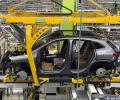
Automobile manufacturers are increasingly vocal about the mounting paperwork and delays associated with India's Production-Linked Incentive (PLI) scheme for the automotive sector, arguing that compliance requirements are becoming as challenging as meeting technical eligibility conditions. They are pushing for a simpler, faster, and more predictable certification and compliance framework.

Tata Motors' MD and CEO, Girish Wagh, has identified rising diesel prices as the most significant threat to India's commercial vehicle (CV) industry recovery, despite the sector recently surpassing its pre-FY19 wholesale peak. Diesel costs account for 25-50% of a truck operator's total cost of ownership, making any increase a critical concern for fleet economics.

JSW MG Motor India has unveiled ADAPT, India's first multi-powertrain new energy vehicle (NEV) platform, designed to support electric, hybrid, plug-in hybrid, and range-extender electric vehicles. The company plans to launch one electric SUV and one plug-in hybrid SUV based on this architecture during FY27, aiming to broaden its NEV portfolio and accelerate adoption in India.

"There is a sharp jump that we have seen in bookings of EVs... The jump, at least in our case, in just two months, it is about 2 to 2.5 times of what it used to be"

Indian benchmark indices Sensex and Nifty rallied in early trade, driven by a significant decline in crude oil prices and positive developments on the geopolitical front, alongside strong performance in blue-chip IT stocks. Track Sensex, Nifty on July 2, 2026

The Delhi government has approved the Delhi EV Policy 2.0, which will phase out fresh registrations of internal combustion engine (ICE) two-wheelers and three-wheelers over the next two years, starting with a ban on ICE 3Ws and N1 category LCVs from January 1, 2027, and ICE 2Ws from April 1, 2028.
Indian stock market benchmark indices Sensex and Nifty closed nearly one per cent higher, extending their winning streak for a second day. This rally was driven by softening crude oil prices, positive geopolitical developments, and significant buying in blue-chip IT stocks, despite a broader global tech sell-off.
Tata Motors on Friday reported a 62.2 per cent decline in consolidated net profit to Rs 4,003 crore in the June quarter, impacted by volume decline across segments, drop in JLR profits due to US tariffs and high base effect due to gain from sale of discontinued operations. The auto major had posted a consolidated net profit of Rs 10,587 crore in the April-June quarter of the previous fiscal, Tata Motors Ltd (TML) said in a regulatory filing.

Indian companies are increasingly opting for demergers, with 29 deals valued at over $40 billion in 2025 alone, marking a 10-year high, as promoters and boards recognise that markets favour focused businesses over complex conglomerates.

'With inflationary pressures now at elevated levels and the adverse cost environment persisting, the company has to pass on a portion of the increased costs to the market, while continuing to ensure that the impact on customers is kept to the minimum extent possible.'
